pie rite

pie rite
An account of my oddyssey through fifty shades of YA

Thursday, July 11, 2013

Fullmetal Alchemist: Vol. 1

Fullmetal Alchemist: Vol. 1 by Hiromu Arakawa (VIZ Media, LLC) ISBN: 978-1-59116-920-8

Plot Summary

Volume 1 introduces the Elrich brothers: Edward (the fullmetal alchemist) and Alphonse. In the world detailed in the Manga, alchemists are able to transform (transmute) materials to create useful objects.  Edward's title -- fullmetal -- refers to his metal arm and leg (though many characters believe that Alphonse is the fullmetal alchemist because he wears -- or more accurately has had his soul bonded to -- a suit of armor).  Edward lost his leg (and Alphonse lost his entire body) in an attempt to transmute materials in order to bring their mother back from the dead.  Edward then sacrificed his arm in order to bind his brother's soul to a suit of armor.  In volume 1, the brothers encounter Father Cornello -- an evangelist using a philosopher's stone to make it appear as though he is performing miracles.  The brothers expose him to his flock and hope to use his philosopher's stone to get their bodies back, but the stone crumbles during one of Cornello's transmutations.  After the brother's leave town, he appears to be eaten by a mysterious fat man with an ouroboros tattoo on his tongue who, along with a woman sporting the same tattoo on her clavicle, accosts Leto.  The narrative picks up again in a coal mining town led by a corrupt government official.  The brothers outwit him, winning the deed to the mines, which they give to the miners in return for room and board.  In the final adventure in the first installment, the brothers find themselves in the midst of a kidnapping aboard a train.  They use their wits, brute strength, and alchemy to overcome the kidnappers.  They also get help from Colonel Mustang (the flame alchemist).  The first volume sets up the major conflict via flashback (the brother seek their bodies throughout the manga) and sets up the mystery of the tattooed pair.


Critical Evaluation

The work is fast paced and rich.  Much of the emotional weight of the first volume comes in the form of flashbacks of an armless Edward screaming and calling out for his brother.  The first incident draws a wonderful parrallel between the boys' current challenge and their ongoing challenge.  Rose, a disciple of Cornello, has been following him due to his promise to bring her dead lover back to life.  The Elrichs, having already attempted the feat, bear the signs of the physical toll of such an endeavor, making the sense of loss palpable and tangible.  The art tends to be highly detailed and cinematic -- though backgrounds are often rendered blank.  This blankness though is appropriate as it doesn't detract attention from the action sequences, which are suspenseful and numerous.

Reader’s Annotation 

Edward Elrich lost an arm and a leg in an attempt to perform alchemy to bring his mother back from the dead.  His brother Alphonse paid the larger price of his whole body.  Edward -- sporting a metal arm and leg -- and Alphonse -- his soul bound to a suit of armor -- roam the world looking for a way to get their bodies back.

Information about the author 

From The Science Fiction Encyclopedia
Pen-name of Hiromi Arakawa (1973-    ), with a vowel shift allowing this female Manga creator to appear to casual Japanese viewers to be male, presumably of some occasional value in her habitual field of comics for boys. A high-school graduate who spent the first seven years of her adult life working on her parents' dairy farm, she moved to Tokyo in 1999 to become an art assistant to the manga artist Hiroyuki Etō. Her independent career, beginning with Stray Dog (graph 1999 Monthly Shōnen Gangan) and the truncated series Shanghai Yōmakikai ["Ghost Demons of Shanghai"] (graph 2000 Monthly Shōnen Gangan), was propelled to a new and internationally successful level with the Seiun Award-winning Hagane no Renkinjutsu-shi (graph August 2001-June 2010 Monthly Shōnen Gangan 27vols; trans as Fullmetal Alchemist 2005-2011 27vols). 
Arakawa's world is strongly rooted in the tropes of Science and Sorcery, beginning in a Parallel World where alchemy and conjuration take the place of science. Her fraternal Antiheroes are maimed apprentices, one seeking to replace lost limbs, the other an entire lost physical form after a disastrous summoning experiment. Their long quest, however, embroils them in the machinations of Secret Masters on their own world of Amestris, and takes a radical turn partway through the narrative, leading to an extended Slingshot Ending with the opening of a gateway to our own Earth, where they are harbingers of the Lost World and Power Source sought by Nazi occultists. Two {ANIME} spin-offs followed from 2003-2004 and more faithfully to the original in 2009-2010, along with a "light novel" series (2004-2010 chap) by Makoto Inoue. 
Arakawa's work has introduced many young Japanese to principles of alchemy and demonology, such that she was also used as the cover illustrator for the Japanese editions of The Demon's Lexicon (2009-2011) by Sarah Rees Brennan. [JonC] (Clute & Langford, 2011).

Genre

Manga

Curriculum Ties

For a work of graphic fiction, Fullmetal Alchemist is dense and literary.  It may be an ideal book for reluctant readers because of its mix of action and an elaborate storyline filled with deception and compassion.

Booktalking Ideas

1) The book is filled with action.  A reading from almost any section will likely spark a reader's interest.
2) You might begin with a question about how far the teens in the audience are willing to go for those they love -- following this with a discussion of the sacrifices of the Elric brothers might help give a sense of the work's tone.


Reading Level/Interest Age

8th grade and up.

Challenge Issues

Violence; negative attitudes towards religion.

I would openly greet any patron who presented a challenge to the work, giving them ample time to detail their complaint.  I would listen attentively.  To respond to these challenges I would have some reviews of the work on hand.   I would be prepared to explain that as a public institution libraries "cannot limit access on the basis of age or other characteristics" (ALA, 1999).  I would have copies of the library's collection policy on hand.  I would be prepared to politely discuss that parents can control what their children are exposed to by coming to the library with them and examining books they check out.  If the Teen Advisory Group had written reviews of the work I'd have them handy.  While it may be of little comfort to certain parents, I would also be prepared to discuss my staunch support of intellectual freedom and abhorrence of censorship.  As a last resort, I would be sure to keep copies or a reconsideration form on hand.

Why did you include this book in the titles you selected?

The book is a highly regarded work of manga and has been adapted into two highly successful anime series: Fullmetal Alchemist and Fullmetal Alchemist: Brotherhood.

References

Clute, J., & Langford, D. (eds.). (2011). Arakawa Hiromu. The Science Fiction Encyclopedia. Retrieved from http://www.sf-encyclopedia.com/entry/arakawa_hiromu 

Tuesday, July 2, 2013

Amanda Palmer performs the popular hits of Radiohead on her magical ukele

Amanda Palmer Performs the Popular Hits of Radiohead on Her Magical Ukelele by Amanda Palmer (8ft. Records) Limited Release, 2010.

Summary

Just as the title suggests this album sees Amanda Palmer (formerly of the Dresden Dolls and currently known for her Kickstarter campaigns and relationship to library lover Neil Gaiman) playing Radiohead songs on her ukelele.  The album was a limited release and came on red vinyl.  

Critical Evaluation

The album seems mostly like a cheeky joke: recreating songs from the artiest band to hit the top 40 in 15 years on a simple four-string instrument.  But the stripped down presentation of these Radiohead songs helps make them Palmer's.  A particular highlight is the song "Idioteque."  The original song is heavily electronic, featuring samples.  Palmer reduces the song to three layers -- piano for the song's prominent musical hook, ukelele to mimic the tape noise and percussion, and her evocative voice: a clear declaration in place of Thom Yorke's muttered original.  She transforms Creep into a slowburn; she imbues the song with the feeling many of her songs have -- a sense of being restorative confessionals.

Reader’s Annotation

One woman, one ukelele, and a handful of songs written by the most revered art rock band of the last 30 years add up to a strange mix of mournful joyousness.

Information about the author

From the website Allmusic.com: 

Before she was the lead singer, pianist, lyricist, and composer for the "Brechtian punk cabaret" duo the Dresden Dolls, Amanda Palmer was a Wesleyan University graduate who had been involved in theater for a number of years. After college, she founded the Shadowbox Collective, a group that performed plays as well as street theater. (Palmer herself was a busker who performed as a living statue.) In 2000 she met drummer Brian Viglione; though Palmer could not read music, she formed the Dresden Dolls a year later and became the main musical force behind the group. She also continued to explore other creative avenues, and in 2006 released The Dresden Dolls Companion, a book that featured original art, a history of the band and its first album, and a partial autobiography by Palmer. At the end of that year, the Dresden Dolls performed the Palmer-penned musical The Onion Cellar with the American Repertory Theatre. In 2008 she released the solo album Who Killed Amanda Palmer, which featured Ben Folds as both a producer and a performer. After paying tribute to Radiohead on the 2010 EP Amanda Palmer Performs the Popular Hits of Radiohead on Her Magical Ukulele, in early 2011 Palmer released Amanda Palmer Goes Down Under, an album filled with references to Australia and New Zealand and written while on tour there. 2012 saw Palmer working towards the release of Theater Is Evil, her first studio album since breaking ties with major labels following Who Killed Amanda Palmer. The album, which featured collaborations with a group of musicians dubbed The Grand Theft Orchestra, was funded by fans through a campaign on the pledge-based fundraising site Kickstarter. The project's original goal of $100,000 was exceeded tenfold, with over a million dollars in pledges being collected. (Fulton, 2013).

Genre

Music: Alternative/Ukelele
 

Curriculum Ties

The album could be used to inspire students to play ukelele.  Palmer typically plays piano, but over the course of 7 songs shows quite a range of sounds that can be coaxed from the Hawaiian instrument.  Palmer is also an inspiring female figure in general because she blazes her own trail and is extremely savvy.

Booktalking Ideas

1) The cover is great fun.

2) The album is really for fans of Amanda Palmer, but because it's a cover album it could be used to expose Radiohead fans to her music.


3) Discussing her use of the Internet to make a living might be an interesting in.

Reading Level/Interest Age

8th grade and up

Challenge Issues

Strong language. 

I would openly greet any patron who presented a challenge to the work, giving them ample time to detail their complaint.  I would listen attentively.  To respond to these challenges I would have some reviews of the work on hand.   I would be prepared to explain that as a public institution libraries "cannot limit access on the basis of age or other characteristics" (ALA, 1999).  I would have copies of the library's collection policy on hand.  I would be prepared to politely discuss that parents can control what their children are exposed to by coming to the library with them and examining books they check out.  If the Teen Advisory Group had written reviews of the work I'd have them handy.  While it may be of little comfort to certain parents, I would also be prepared to discuss my staunch support of intellectual freedom and abhorrence of censorship.  As a last resort, I would be sure to keep copies or a reconsideration form on hand.
Why did you include this book in the titles you selected?

Amanda Palmer is a force on the Internet.  She's essentially the poster-child for earning a living through music without the aid of a record label.  Also, her 2008 album Who Killed Amanda Palmer was a masterpiece.

References

American Library Association. (1999). Strategies and tips for dealing with challenges to library materials. Retrieved from http://www.ala.org/advocacy/banned/challengeslibrarymaterials/copingwithchallenges/strategiestips

Fulton, K. (2013). Amanda Palmer: Biography. Retrieved from http://www.allmusic.com/artist/amanda-palmer-mn0000089870/overview/main#discography

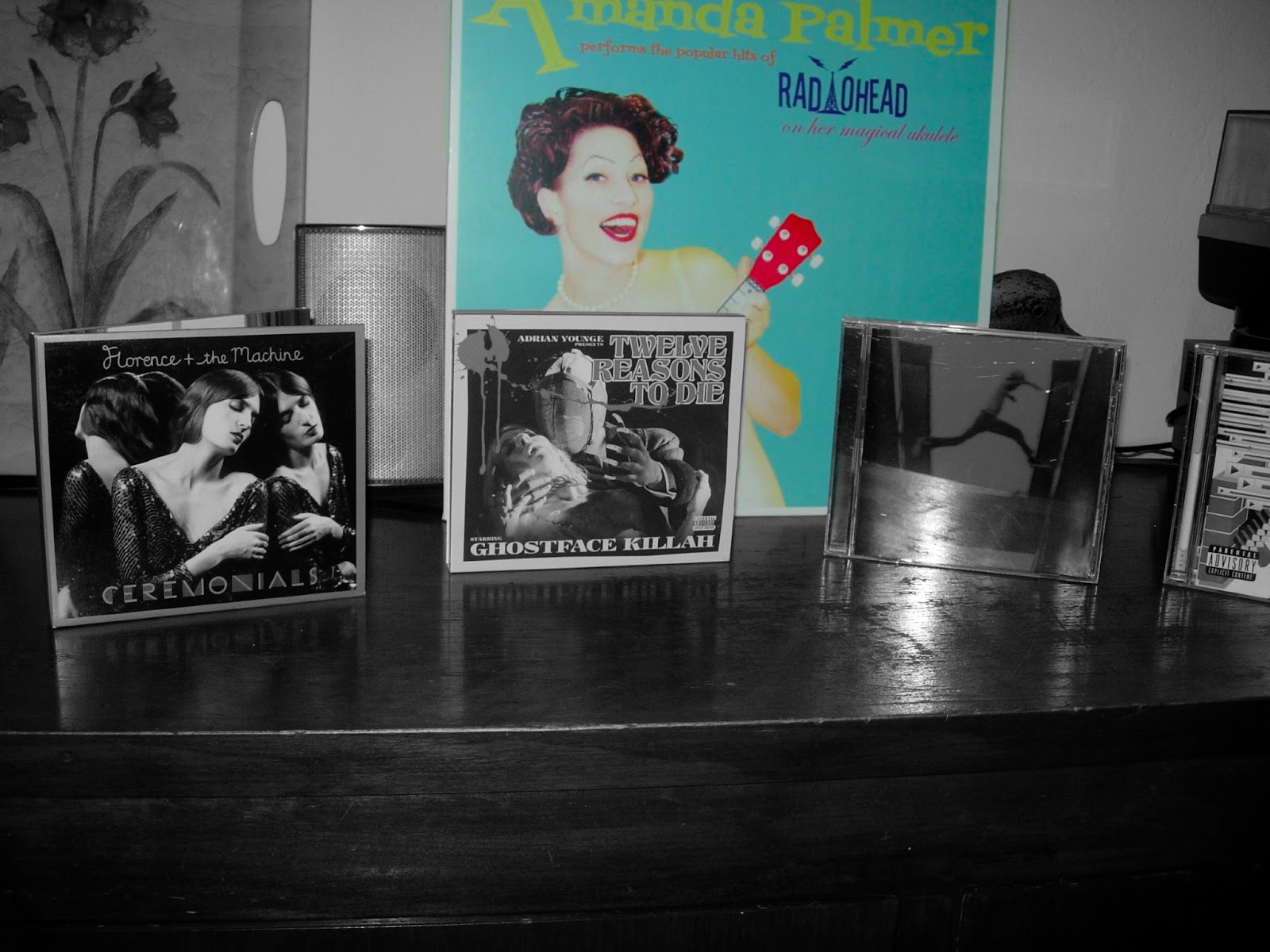
Ceremonials

Summary

Ceremonials is instrumentally minimal with layers of rich, full vocal tracks.  It's a dance album, but not a frantic one (due in part to the spare instrumental tracks).  Welch belts at times, as on the chorus to "Shake It Out" "it's hard to dance with the devil on your back, so shake him off."  But for her belted vocals aren't strained: they have the quality of a gospel singer. The vocal performance is the primary focus of each song.

Critical Evaluation

The cover and liner notes of Florence & the Machine's second album Ceremonials seem to be dedicated to a photo shoot for singer Florence Welch: with Welch as a 40s film star.  This is a statement in itself.  In an era when many female artists adopt over-sexualized personalities to sell albums, Welch stands out.  This is clear not only from her fully clothed, sophisticated image, but also in the music.  There is nothing sultry about her vocal delivery: she emits a clear power.  It's a feminine power, but not one steeped in sex (think Britney Spears or Katy Perry's skimpy wardrobes or Lana Del Rey's smokey, sexy vocal delivery).  Like the album's cover, the songs are theatrical: carrying the drama (but not the cutesy lyrical word play or the standard key changes) of musical theater.  The music is anthemic, but Welch doesn't write anthems; it's grandiose, but it's not bombastic.

Reader’s Annotation

Ceremonials is vocally driven, danceable, energizing music: an oasis in a frenetic pop landscape filled with sci-fi synths and overly syncopated drum beats.

Information about the author

From the band website: 


Let’s talk about magic. Because music, at its best, is a kind of magic that lifts you up and takes you somewhere else. “I want my music to sound like throwing yourself out of a tree, or off a tall building, or as if you’re being sucked down into the ocean and you can’t breathe,” says Florence Welch. “It’s something overwhelming and all-encompassing that fills you up, and you’re either going to explode with it, or you’re just going to disappear.” 

Florence writes her best songs when she’s drunk or has a hangover, because that’s when the freedom, the feral music comes, creating itself wildly from the fragments gathered in her notebooks and in her head. “You’re lucid,” she explains, “but you’re not really there. You’re floating through your own thoughts, and you can pick out what you need. I like those weird connections in the universe. I feel that life’s like a consistent acid trip, those times when things keep coming back.” 

Florence herself is a mass of contradictions: she’s tough yet she’s terrified, a bundle of nerves and passion, of darkness and pure joy. “I feel things quite intensely, which is why the music has to be so intense. I’m either really sad or really happy, I’m tired or completely manic. That’s when I’m at my most creative, but it’s also dangerous for me. I feel I could write some good songs, or break some hearts. Or tables. Or glasses.” 

As a performer she can seem fearless, but she’s also far too quick to pass judgement on herself. This is the woman, after all who got into Camberwell art college by making a huge floral sign telling herself ‘You are a twat.’ She says she’s a geek, who loses all control when in love. She’s also something increasingly rare and precious in a time of karaoke pop: an artist who has found her own, authentic voice. 

Her soaring, epic vocals, quirky melodies and self-contained musical world have already won her the 2009 Critics Choice Award at the Brits. Some compare her to Kate Bush. You’ll also find touches of Tom Waits and Nick Cave in her dark visions, and if you heard a little of Bjork too, she’d find it a compliment. But mainly, Florence is out on her own: an exhilarating place to be, she points out, but also a little scary. Her debut album ‘Lungs’ is made of harps, choirs, drums, elevator shafts, bits of metal, love, death, fireworks, string quartets, stamping, sighing, strange electronic wailing, lambs, lions, sick, broken glass, blood, moon, stars, drink, coffins, teeth, water, wedding dresses, and the silences in between.  (Island Universal Records, 2012).

Genre

Music: Alternative Dance

Curriculum Ties

Welch's vocal style would warrant study by a chorus.  Her marketed image may also warrant study in any class that examines culture.

Booktalking Ideas

1) "Shake it Out" probably has the hookiest chorus.  Playing this song might intrigue potential listeners.
2) Showing the glamorous photographs of the cover might also spark conversation about the album.


Reading Level/Interest Age

7th grade and up.

Challenge Issues

Some parents are opposed to secular music.  Some lyrics can be dark (there are songs about death and drowning).  Welch was discovered when she was drunk and singing in a bathroom; this story may be unappealing to parents.  As a person, she may say things parents don't want to hear.

I would openly greet any patron who presented a challenge to the work, giving them ample time to detail their complaint.  I would listen attentively.  To respond to these challenges I would have some reviews of the work on hand.   I would be prepared to explain that as a public institution libraries "cannot limit access on the basis of age or other characteristics" (ALA, 1999).  I would have copies of the library's collection policy on hand.  I would be prepared to politely discuss that parents can control what their children are exposed to by coming to the library with them and examining books they check out.  If the Teen Advisory Group had written reviews of the work I'd have them handy.  While it may be of little comfort to certain parents, I would also be prepared to discuss my staunch support of intellectual freedom and abhorrence of censorship.  As a last resort, I would be sure to keep copies or a reconsideration form on hand.


Why did you include this book in the titles you selected?

It is both current and popular.  It appeals to a wide audience and features a strong female artist.

References

American Library Association. (1999). Strategies and tips for dealing with challenges to library materials. Retrieved from http://www.ala.org/advocacy/banned/challengeslibrarymaterials/copingwithchallenges/strategiestips

Island Universal Records, Ltd. (2012). About. Retrieved from http://florenceandthemachine.net/biography

Twelve Reasons to Die

Adrian Younge Presents Twelve Reasons to Die by Ghostface Killah (Soul Temple) ASIN: B00BMEF7GK

Summary

Twelve Reasons to Die is a concept album about an Italian mobster -- Tony Starks (not to be confused with Tony Stark a.k.a. Iron Man, though Ghostface Killah does also go by Ironman) -- who is betrayed and murdered.  His remains are pressed into 12 vinyl records.  Playing them returns his soul to the world of the living.  To enact his revenge he takes on the form of the Ghostface Killah -- imagined here as a kind of black superhero murderer.  Much of the album focuses on Starks life before he is murdered.  The final tracks of the album recount the gruesome deaths that the Ghostface Killah performs.

Critical Evaluation

The album has been lauded for its production work by Adrian Younge.  Indeed this aspect of the album is impressive.  Younge did the soundtrack for the 2009 film Black Dynamite and for a 2013 Delfonics album.  In Black Dynamite, Younge affects a 1970s blaxplotation funk soundtrack vibe (reminiscent of Curtis Mayfield or Isaac Hayes).  On Twelve Reasons to Die, Younge channels a 1970s B-movie vibe.  His inspiration is reportedly Italian composers.  And the production is spot-on.  The music is evocative of a genre film from the period.  While the instrumentation transcends cliches, the lyrics seem content to wallow in them.  Upon hearing the notion of a hip-hop concept album, one might imagine an artistic statement that transcends the worst features of the genre.  Instead Ghostface Killah hews close to the blueprint of gangsta rap.  The concept becomes a stage for violence, betrayal by women, and boasting.  We might expect a high concept revenge story, to follow a revenge tragedy narrative.  This album does not.  The narrative is simply that Starks is murdered and in the guise of Ghostface Killah exacts gruesome revenge.  At this point in time it's impossible not to see hip-hop concept albums in the shadow of Deltron 3030.  On that album Del the Funkee Homosapien seems to look into the inspirations of hip-hop music (namely Parliament Funkadelic), latch onto the imagery (particularly the science fiction element of Parliament's Mothership), and create a humorous, yet technically proficient opus.  The concept of the rap battle is re-imagined as an intergalactic war of wills.  Twelve Reasons to Die does not offer as many inventive ways of looking at Rap. It's themes are much like those explored on Straight Outta Compton; they are simply relocated into the world of organized crime.

Reader’s Annotation

Ghostface Killah's concept album is the soundtrack to a non-existent horror/revenge film.  The production is spectacular and Ghostface Killah's verbal acrobatics are on display.

Information about the author

From the website Allmusic.com: 


As one of the original members of the seminal '90s rap crew the Wu-Tang Clan, Ghostface Killah (aka Tony Starks) made an impact before he released his debut album, Ironman, late in 1996. Like all members of the Wu-Tang Clan, the rapper used the group as a launching pad for a solo career, which was assisted greatly by other members of the Clan, particularly producer RZA. Ghostface Killah had rapped on Wu-Tang's 1993 debut, Enter the Wu-Tang, but he didn't distinguish himself until 1995, when he was showcased on fellow Wu member Raekwon's Only Built 4 Cuban Linx. Ghostface received good reviews for his appearance on the record, and his contribution to the soundtracks for Sunset Park and Don't Be a Menace to South Central While You're Drinking Your Juice in the Hood also were well-received. All of these guest appearances and soundtrack contributions set the stage for Ghostface Killah's solo debut, Ironman, in late 1996. Like all Wu-Tang projects, it was produced by RZA and was quite successful in the large hip-hop/rap underground, debuting at number two on the pop charts upon its release. Ironman was also the first album to be released on Razor Sharp Records, RZA's record label on Epic Records. (Thomas Erlewine, 2013).

Composer, arranger, producer, and multi-instrumentalist Adrian Younge -- also a film editor, business owner, and entertainment law professor -- quickly transitioned from sampling records with an MPC to playing several instruments. During the late '90s, he performed bass and keyboards in a band but grew frustrated with relying upon his mates, so he adapted by learning to play more instruments, as well as the ins and outs of analog recording. Drawing from his love for Italian film music, he conceived Venice Dawn and circulated 1000 copies of an EP he wrote, played, and produced in full. Several years later, he was asked to edit a Blaxploitation-style film titled Black Dynamite, and he also provided the music. Released in 2009 on the record label of Wax Poetics magazine. In late 2011, Venice Dawn was revived (and eventually expanded into a performing group) for the sake of Something About April, another nostalgic yet utterly unique recording steeped in late-'60s and early-'70s psychedelic soul. Although it seemed custom-made for sample hounds, it was thoroughly engrossing from front to back, with equal emphasis on songwriting and production. Younge subsequently worked with one of his favorite soul groups, the Delfonics. The collaboration led to Adrian Younge Presents the Delfonics, released on Wax Poetics in March 2013. A busy man, Younge also operates the Artform Studio, a record store and salon located in Los Angeles, California. (Kellman, 2013)

Genre

Music: Hip-Hop
 

Curriculum Ties

The lyrical themes of the album may not warrant discussion at the highschool level.  However, the production by Adrian Younge is worthwhile (and also available without the vocal parts as a separate disc).  The album could be used to encourage students who are fans of Hip-Hop to write stories.

Booktalking Ideas

I find it unlikely that I'd go out of my way to recommend this specific album.  It is compelling though that Ghostface Killah and Younge took a risk and made a concept album.  Younge's production might spark interest in scoring film.  Discussing that process might interest some listeners.

Reading Level/Interest Age

9th grade and up

Challenge Issues

Strong language; violent imagery. 

I would openly greet any patron who presented a challenge to the work, giving them ample time to detail their complaint.  I would listen attentively.  To respond to these challenges I would have some reviews of the work on hand.   I would be prepared to explain that as a public institution libraries "cannot limit access on the basis of age or other characteristics" (ALA, 1999).  I would have copies of the library's collection policy on hand.  I would be prepared to politely discuss that parents can control what their children are exposed to by coming to the library with them and examining books they check out.  If the Teen Advisory Group had written reviews of the work I'd have them handy.  While it may be of little comfort to certain parents, I would also be prepared to discuss my staunch support of intellectual freedom and abhorrence of censorship.  As a last resort, I would be sure to keep copies or a reconsideration form on hand.

Why did you include this book in the titles you selected?

Ghostface Killah is a founding member of the popular Hip-Hop group the Wu Tang Clan.  Additionally, a mixtape from last year pairing Ghostface Killah's rhymes with the instrumentation of Fela Kuti albums caught my ear.  I was also a fan of Adrian Younge's Delfonics album from 2013.

References

American Library Association. (1999). Strategies and tips for dealing with challenges to library materials. Retrieved from http://www.ala.org/advocacy/banned/challengeslibrarymaterials/copingwithchallenges/strategiestips


Kellman, A. (2013). Adrian Younge: Biography. Retrieved from http://www.allmusic.com/artist/adrian-younge-mn0001646944

Thomas Erlewine, S. (2013). Ghostface Killah: Biography. Retrieved from http://www.allmusic.com/artist/ghostface-killah-mn0000655746

The Ecstatic

The Ecstatic by Mos Def (Downtown) ASIN: B001GSV3F6

Summary

Mos Def's 2009 (and most recent album) is 16 tracks long.  His collaborations with Slick Rick on "Auditorium", and with his former band mate (and candidate for world's greatest rapper of all time) Talib Kweli on "History" are highlights.  "Auditorium" is a shapeless description of negative feelings until the first 8 Slick Rick lines, which masterfully locate the action in Iraq and describe the feelings of the locals towards G.I.s -- despite the dark tone at the beginning of each verse, the song becomes a celebration of art and thought.  Slick Rick turns "a young Iraqi kid" into "the Elvis of Baghdad" when he raps over "the Middle Eastern instruments."  Mos Def keeps the idea of art triumphing over political difference from feeling corny by showing how music can be a place where cultures can intersect -- the backing track for the song includes a Middle Eastern instrumental arrangement in a reflection of the sentiment that Slick Rick offers.  The hook of "History" is that Kweli and Mos Def rap over a record that keeps changing speed.  This provides them an opportunity to show their flexibility and the full range of their skill.  While this may sound contrived, compare the variety of this single song with a Snoop Dogg album.  His style is so limited that the songs begin to sound the same.

Critical Evaluation

The album opens with Mos Def whispering an Arabic phrase that loosely translates as "In the name of God, most Gracious, most Compassionate."  This is immediately followed by a clip of Malcolm X.  The album cover is a still photograph from the film Killer of Sheep directed by Charles Burnett.  The album cover gives a truer indication of the album's content than the Malcolm X quotation (though the politic does work its way into the album, sometimes in subtle ways: being joyful and black seems political at times).  The album is more of an artistic endeavor than a political one.  The album consists of a series of short songs, often without a chorus.  The result is that the album feels like a cohesive whole even though there isn't necessarily a unifying theme.  Though the notion of the ecstatic does flow throughout, the album tends to find a positive message throughout.  It's a pleasure to listen to.

Reader’s Annotation

Mos Def returns with his best album in 10 years, and it's an artful statement.  Come for the inventive instrumentation (like the tuba bass line on "Twilite Speedball"), stay for the Blackstar reunion on "History."

Information about the author

From the website Allmusic.com: 

Initially regarded as one of the most promising rappers to emerge in the late '90s, Mos Def turned to acting in subsequent years as music became a secondary concern for him. He did release new music from time to time, including albums such as The New Danger (2004), but his output was erratic and seemingly governed by whim. Mos Def nonetheless continued to draw attention, especially from critics and underground rap fans, and his classic breakthrough albums -- Black Star (1998), a collaboration with Talib Kweli and Hi-Tek; and Black on Both Sides (1999), his solo debut -- continued to be revered, all the more so as time marched forward. Mos Def often used his renown for political purposes, protesting in the wake of Hurricane Katrina in 2005 and the Jena Six incident in 2007, for instance.  (Birchmeier, 2013).

Genre

Music: Hip-Hop

Curriculum Ties

The album could be used in a social studies class to describe responses to Iraq war and the Bush administration.  It is also an example of innovative musical ideas in Hip-Hop, so a class or club on music production might get a lot of mileage out of the album.  With its quotation from Malcolm X, it might also be interesting to discuss the album in light of the civil rights movement and discuss what impact that era may have had on the album or what connections could be made between 2009 and 1964.

Booktalking Ideas

1) While this isn't perhaps a booktalking idea for the album, it's interesting that Mos Def chose a still from the film Killer of Sheep.  The album might be useful in a film talk about that movie -- an art film by the African American director Charles Burnett.

2) The album speaks for itself.  Playing a track from the album would be a good hook.  The songs "The Embassy," and "No Hay Nada Mas" might be particularly good for encouraging listening.  "No Hay Nada Mas" is in Spanish, which might be appealing.  The track "Roses" is perhaps the weakest.  It's actually a fine song by Georgia Anne Muldrow, but beyond the added beat, the song is little changed from her album.  Mos Def adds what feels like extemporaneous rap lyrics over her song, but it doesn't add much to Muldrow's track.  The song would work as well without Mos Def.  (It's the only misstep on the album.)


Reading Level/Interest Age

8th grade and up

Challenge Issues

Strong language; political lyrics. 

I would openly greet any patron who presented a challenge to the work, giving them ample time to detail their complaint.  I would listen attentively.  To respond to these challenges I would have some reviews of the work on hand.   I would be prepared to explain that as a public institution libraries "cannot limit access on the basis of age or other characteristics" (ALA, 1999).  I would have copies of the library's collection policy on hand.  I would be prepared to politely discuss that parents can control what their children are exposed to by coming to the library with them and examining books they check out.  If the Teen Advisory Group had written reviews of the work I'd have them handy.  While it may be of little comfort to certain parents, I would also be prepared to discuss my staunch support of intellectual freedom and abhorrence of censorship.  As a last resort, I would be sure to keep copies or a reconsideration form on hand.

Why did you include this book in the titles you selected?

Mos Def is one of Hip-Hop's biggest luminaries.  His public profile is made even higher by his appearance in Hollywood films and his political action (recently he was force-fed on camera to show what inmates at Guantanamo are going through).  He was also featured on the Gorillaz album Plastic Beach.

References

American Library Association. (1999). Strategies and tips for dealing with challenges to library materials. Retrieved from http://www.ala.org/advocacy/banned/challengeslibrarymaterials/copingwithchallenges/strategiestips

Birchmeier, J. (2013). Mos Def: Biography. Retrieved from http://www.allmusic.com/artist/mos-def-mn0000927416


/\/\ /\ Y /\


/\/\ /\ Y /\ by M.I.A. (Interscope) ASIN: B003X03D58

Summary

The album is a series of abrasive dance songs (save for "XXXO").  Some are political; some are about partying.  There doesn't appear to be a unified message for the album.  The intent seems to be challenge her casual listeners.

Critical Evaluation

Maya Arulpragasam (M.I.A.) is an incredible pastiche artist.  Her early records include samples of songs by The Clash and the Pixies looped and skewed to create contemporary pop fare that can easily sneak onto the radio (see "Paper Planes" from her second full length album Arular).  The self-titled third album (spelled in a kind of l33t speak with slashes) is by far her most challenging.  Most tracks are dense sound collages.  But she still manages to sneak in pop confections like XXX0 as though they were songs she could write in her sleep.  She also samples "Ghostrider" by Suicide for "Born Free."  Suicide, with their abrasive attitudes and confrontational songs are not a typical group for samples.  M.I.A., like Florence Welch, uses her vocals to express a kind of power.  Here vocal range is not as varied as Welch, and her delivery is not rich or lush.  She relies on vocoders or tends towards rapping.  Her strength is certainly in the way she layers musical tracks: in this way she is very much the opposite of Welch.  Also, unlike Welch, Arulpragasam is willing to use sexuality in the tracks -- though she usually twists it, as in one of my favorite choruses of 2010.  It begins sounding like a standard pop starlet "You want me / XXXO / You want me / XXXO," but she twists it to "You want me be somebody that I'm really not."  The line sounds like a kiss off not only to potential suitors, but also to critics who had pigeonhold M.I.A. as a pop artist.  The album sits in a punk tradition of an album that attempts to steer an artist out of the mainstream -- Nirvana's In Utero, for example, was much more challenging than Nevermind (or the Clash's triple album "Sandinista," which with its confrontational name and daunting run-time almost ensured a lack of commercial success).  The album seems to achieve its aims as M.I.A.'s least critically adored work.

Reader’s Annotation

M.I.A. is an audio bricoleur.  She hoards old records and sounds like a squirrel hoards acorns; then she transmutes them and adds to them creating sounds that are at once familiar and pleasing but also peculiar and abrasive.


Information about the author

From the website Allmusic.com: 

Maya Arulpragasam spent the early years of her life in a number of places. She moved from London, England, to her parents' native Sri Lanka at the age of six months, only to relocate to Madras, India. During a return stay in Sri Lanka, the civil war taking place within the country escalated to the point where Arulpragasam began to lose family members and friends. She didn't see her father -- a devout and active separatist as part of the Tamil rebellion, which has clashed with the Sinhalese majority -- often throughout these years, but her life stabilized once she and the rest of her family were able to make it back to London. 

As a student, Arulpragasam became involved in the arts and published a monogram book of her paintings -- titled M.I.A. and heavily influenced by the Tamil rebellion. She later connected with Elastica, providing the photography and graphics for the group's second album, and she shot footage during their American tour. Elastica's support act, Peaches, introduced her to the Roland MC-505, a sequencer she became familiar with after returning home. Steve Mackey (Pulp) and Ross Orton became involved after hearing a demo; they made adjustments to "Galang," a song that was then pressed into 500 copies and released, under the name M.I.A., by the Showbiz label. It didn't take long for the song -- a bold, righteous amalgamation of hip-hop, electro, dancehall, grime, and baile funk -- to make an impact with DJs. She wound up signing a contract with XL, which re-released the single and, eventually, debut album Arular in 2005. Anticipation for the release was considerable, only heightened by the Piracy Funds Terrorism mixtape she put together with DJ Diplo. 

Her second album, Kala, was released in 2007 and was recorded while she spent time in numerous countries. M.I.A. produced most of its tracks with Switch; Blaqstarr, Diplo, and Timbaland also contributed. One single from the album, "Paper Planes," became a surprise hit in summer 2008 after it was used in trailers for the film Pineapple Express; it eventually reached the Top Ten. The soundtrack for the Academy Award-winning Slumdog Millionaire also featured M.I.A.'s music; the release featured new material from the artist and was the first disc issued on her N.E.E.T. label. /\/\/\Y/\, the third M.I.A. album, was released in 2010. (Kellman, 2013)

Genre

Music: Alternative Dance

Curriculum Ties

There aren't particularly clear curriculum ties.  The album might warrant study in a course on music production.  While she dedicates the album to the Tamil people, few of the songs are overtly political -- though certainly some are.  These songs may be appropriate in a social studies course examining the conflicts in Sri Lanka.


Booktalking Ideas

1)"XXXO" is catchy, but not representative of the rest of the album.  It may be the greatest hook though.
2) The first song "The Message" might give a good sense of M.I.A.'s politics "head bone connected to the earphones, earphones connected to the iPod, iPod connected to the Internet, connected to the Internet, connected to the Google, connected to the Government."  This could be read as skepticism or wariness (though it could also be read as paranoia).

Reading Level/Interest Age

9th grade and up.

Challenge Issues

Strong language; lyrics about alcohol and drugs; criticism of the Bush administration; sexuality.  The liner notes contain images of violence (and her music video for "Born Free" featured both nudity and violence though to a political end).

I would openly greet any patron who presented a challenge to the work, giving them ample time to detail their complaint.  I would listen attentively.  To respond to these challenges I would have some reviews of the work on hand.   I would be prepared to explain that as a public institution libraries "cannot limit access on the basis of age or other characteristics" (ALA, 1999).  I would have copies of the library's collection policy on hand.  I would be prepared to politely discuss that parents can control what their children are exposed to by coming to the library with them and examining books they check out.  If the Teen Advisory Group had written reviews of the work I'd have them handy.  While it may be of little comfort to certain parents, I would also be prepared to discuss my staunch support of intellectual freedom and abhorrence of censorship.  As a last resort, I would be sure to keep copies or a reconsideration form on hand.

Why did you include this book in the titles you selected?

I'm an M.I.A. fan, and I like this album though it was her least successful critically.  Also she performed 9 months pregnant at the Grammy Awards challenging our concept of how pregnant women should behave.

References

American Library Association. (1999). Strategies and tips for dealing with challenges to library materials. Retrieved from http://www.ala.org/advocacy/banned/challengeslibrarymaterials/copingwithchallenges/strategiestips

Kellman, A. (2013). M.I.A.: Biography. Retrieved from http://www.allmusic.com/artist/mia-mn0000388773

Ghostopolis

Ghostopolis by Doug Tennepal (Scholastic) ISBN: 978-0-545-21027-0 (painting and photo by my wife)

Plot Summary

Garth has a terminal disease; there's no cure and he's going to die.  He also happens to live in a world where ghosts frequently pop in from the afterlife.  Frank Gallows, a ghost hunter chasing a night mare (a skeletal horse), accidentally sends Garth to Ghostopolis with the mare.  Gallows wants to head the extraction team to rescue Garth, but his boss Lieutenant Brock takes him out of the field.  Determined to make up for his mistake, Gallows calls on his former flame: the ghost Claire Voyant.  She's been working on a machine to get to the other side.  In the afterlife things have been looking bad.  A living mortal named Vaugner (? a reference to the composer Wagner?) has taken everything over, summoned bugs from the underworld as muscle, and rules with a fleshy grip (humans aren't constrained by the physics of the afterlife, so they have special power: flight & the ability to summon and throw plasma balls.  Vaugner fears Garth because Garth has great power.  Garth and Vaugner eventually battle one another in an epic fight where they both use telekinesis to reshape the buildings around them and fight like Japanese Kaiju (you know like Mothra v. Godzilla).  Even after defeating Vaugner, where does this leave Garth?  He's still ill.  The track record of father's in his family is still poor.  And how can Gallows and Voyant overcome their most basic difficulty -- he's alive and she's a ghost.  

Critical Evaluation

The full color artwork is wonderful and inventive.  And Tennapel knows when pictures will drive the action better than words.  His style is cinematic and full.

(Tennapel, 2010, p. 30-31)

Because the book can be read in about an hour due to the low amount of dialogue and sections like the above, the book might be ideal for reluctant readers or struggling readers.  The book is fast paced, filled with action and humor, and imaginative art work  (including a 12-foot Tuskegee Airman with a glowing green aura, a man-sized cricket with a Snidely Whiplash mustache, and a mummified T-rex).

Reader’s Annotation 

Garth -- a young boy with a terminal illness -- accidentally gets sent to the afterlife by ghost detective Frank Gallows.  Now Gallows and his girlfriend Claire Voyant have to travel to the afterlife to save Garth from bugs from the underworld and Voyant's ex-boyfriend Vaugner who rules Ghostopolis.

Information about the author 

Doug Tennapel is perhaps best known (at least by me) for creating the cult classic videogame Earthworm Jim (or as true fans call it EWJ, since the abbreviation actually has more syllables than the written out title).  Other notable works by Tennapel include The Neverhood (a PC game), the cartoons Catscratch and an animated series focused on Earthworm Jim.  He's published a series of children's books: 

Doug's 5 children's book series called "The Strange Kid's Chronicles" were published by Scholastic. They're out of print and getting difficult to find. The covers were illustrated by Michael Koelsch.(Tennapel, 2013).
He's also written the comic books/graphic novels Tommysaurus Rex, Cardboard, Powerup, Ratfist, and Earthboy Jacobus among others.  

Genre

Graphic novel/adventure/fantasy

Curriculum Ties

The book wouldn't likely fit many specific curricular concerns, but it might be useful for getting struggling or reluctant readers reading.  It might also be a fun option as a summer reading suggestion.

Booktalking Ideas

1) Describe or read some of the humorous passages (pages 130 to 131 offer the dining options of Ghostopolis: tarantula on a stick or mummified elephant poop).
2) Show some of the more inventive pictures.


Reading Level/Interest Age

6th grade and up.

Challenge Issues

Violence; the book also deals with death.

I would openly greet any patron who presented a challenge to the work, giving them ample time to detail their complaint.  I would listen attentively.  To respond to these challenges I would have some reviews of the work on hand.   I would be prepared to explain that as a public institution libraries "cannot limit access on the basis of age or other characteristics" (ALA, 1999).  I would have copies of the library's collection policy on hand.  I would be prepared to politely discuss that parents can control what their children are exposed to by coming to the library with them and examining books they check out.  If the Teen Advisory Group had written reviews of the book I'd have them handy.  While it may be of little comfort to certain parents, I would also be prepared to discuss my staunch support of intellectual freedom and abhorrence of censorship.  As a last resort, I would be sure to keep copies or a reconsideration form on hand.
 

Why did you include this book in the titles you selected?

I'm a big Earthworm Jim fan (such a great game, mostly for its animation style).

References

American Library Association. (1999). Strategies and tips for dealing with challenges to library materials. Retrieved from http://www.ala.org/advocacy/banned/challengeslibrarymaterials/copingwithchallenges/strategiestips


Tennapel, D. (2010) Ghostopolis. New York: Scholastic.


Tennapel, D. (2013). Children's publishing. Retrieved from http://tennapel.com/childrencreate.html